

Home for Dental Implants, Cosmetic Dentistry near me
Implants, Invisalign, crowns, emergencies, costs, and what happens at your first visit.
Look at three things. How long they have been practicing, whether they explain treatment before they start it, and what their patients say. Ask to see before and after photos of cases like yours. A dentist who is comfortable showing you their own work is usually one worth trusting.
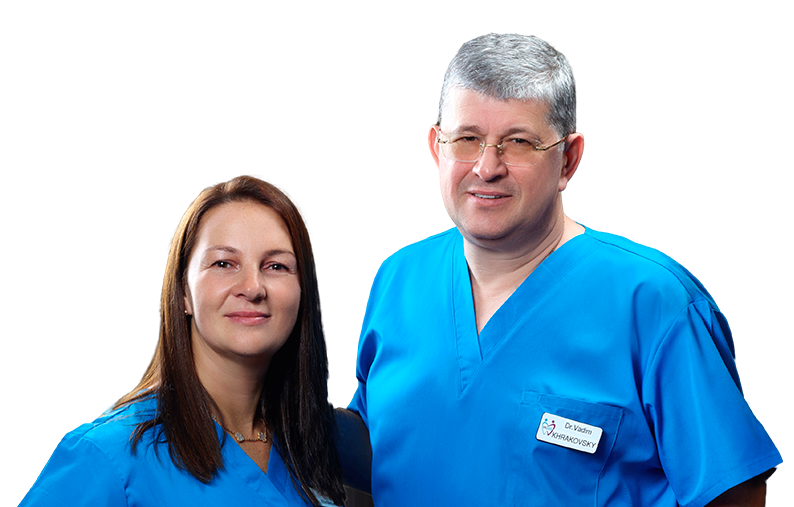
We have been in the same Coney Island neighbourhood since 1992. The practice is run by a husband and wife team. Dr. Vadim Khrakovsky handles the surgical and implant side, Dr. Vera Khrakovsky handles Invisalign and restorative work, so most cases stay under one roof.
Two things come up again and again in our patient reviews: the staff are friendly, and the explanations are clear.
Dr. Vadim Khrakovsky, DDS founded the practice in 1992. He earned his DDS at NYU College of Dentistry, taught there as a clinical professor for five years, and focuses on implants, All-on-X and surgical dentistry.
Dr. Vera Khrakovsky, DDS earned her DDS at NYU in 2000. She is an Invisalign Pearl Provider and focuses on clear aligners and crown and bridge work.
Dr. Victor Popandopoulo also practices with us. You can meet the whole team here.
Since 1992. Dr. Vadim opened the doors the same year he graduated from NYU College of Dentistry, and the practice has been in Coney Island ever since. That is more than thirty years in one neighbourhood.
We are at 2791 W 5th St, Brooklyn, NY 11224, in Coney Island.
By subway: we are near the F, Q and N lines.
By bus: the B36, B4 and B68 all run nearby.
Driving: street parking is available around the office.
We see patients from across southern Brooklyn, including Brighton Beach, Sheepshead Bay, Gravesend, Bensonhurst and Bath Beach. Call 646-859-7048 if you need directions.
Monday 9am to 5pm
Tuesday 9am to 8pm
Wednesday 9am to 8pm
Thursday 9am to 6pm
Friday 9am to 6pm
Saturday 9am to 4pm
Sunday closed
Tuesday and Wednesday evenings are the latest we run, which helps if you cannot get away during the day.
Yes. We have Russian speaking staff, and Dr. Vadim trained at the Moscow Stomatological Institute before NYU. If it is easier for you to discuss treatment in Russian, just say so when you call.
Yes. The office is wheelchair accessible, including the restroom.
If you have specific access needs, call ahead at 646-859-7048 and we will make sure everything is ready before you arrive.
Plan on about an hour. We take a full set of x-rays, do a complete exam, and then sit down and talk through what we found. You leave knowing what is going on in your mouth and what your options are.
We do not rush this part. It is the visit that everything else is built on, whether that turns out to be routine general dentistry or something bigger.
About an hour, and that is deliberate. We would rather spend the time up front and get the diagnosis right than move you through quickly and miss something.
A list of any medications you take, and any recent x-rays or records from a previous dentist if you can get them. Neither is essential. If you are in pain, just come in.
Yes. When you schedule your new patient appointment we send your forms over so you can fill them in beforehand. That way your appointment time goes to your teeth rather than paperwork.
For emergencies, always. If you are in pain or something has broken, call or come in and we will fit you in.
For routine visits like cleanings and checkups, calling ahead gets you a time that actually suits you.
Our new patient special is $225 and covers a full mouth set of x-rays, a complete exam, and a cleaning.
That is the visit where we work out what is actually going on, so you leave with a clear picture rather than a guess. See our preventative care page for what routine visits cover after that.
Yes. We work with Cherry and CareCredit, both of which let you spread the cost of treatment over time rather than paying it all at once.
This matters most for larger cases like implants, All-on-X or full mouth work. Ask us at your consultation and we will walk you through what is available for your treatment plan.
The implant itself, the titanium post in the jaw, is built to last decades and often lasts for life. The crown on top takes the chewing wear and usually needs replacing somewhere around ten to fifteen years.
What matters most is the gum and bone around it staying healthy, which comes down to brushing, flossing and keeping up with checkups.
An implant replaces the root of a missing tooth. A small titanium post is placed into the jawbone, and over a few months the bone grows around it and locks it in. Once it is solid, a custom crown goes on top.
The result looks and works like a natural tooth, and it does not rely on the teeth either side of it. More on our dental implants page.
Usually three to six months from placement to final crown, because the bone needs time to fuse to the implant. If a bone graft is needed first, add a few months to that.
In some cases the implant can go in the same day the tooth comes out. See immediate dental implants for when that is possible.
Most patients tell us it was easier than they expected, and easier than having a tooth pulled. The area is fully numbed for the procedure itself, so you should not feel the placement.
Afterwards there is usually some soreness for a few days that over the counter pain relief handles for most people.
No, not unless every tooth genuinely needs to come out. If you are missing one tooth, you get one implant.
Full arch treatments like All-on-X are for people who have already lost most or all of the teeth in an arch, or whose remaining teeth cannot be saved.
Most adults are. What matters is having enough healthy bone to hold the implant and gums free of active infection. Smoking and some medical conditions can slow healing.
A 3D scan tells us quickly whether the bone is there, and if it is not, whether grafting can build it up.
All-on-X is a full arch of fixed teeth supported by four or more implants. It is for people who have lost most or all of the teeth in one jaw, or who are tired of dentures that shift and click.
The teeth are fixed in place, so they do not come out at night. Read more about All-on-X implants.
Four things mainly. Whether you need an extraction or bone graft first, how many implants you need, the material used for the crown, and how complex the surgery is.
In Brooklyn, a single tooth implant including the post, abutment and crown generally falls somewhere in the $3,000 to $6,000 range. Full arch treatment is a different scale, typically $15,000 to $30,000 per arch.
Those are general market ranges, not a quote. The only way to know your number is an exam, and we will give you the full figure in writing before anything starts.
Yes, two. A bridge replaces a missing tooth by anchoring to the teeth either side. A partial denture is removable and costs least of all.
Both are cheaper up front. The trade off is that a bridge means preparing two healthy teeth, and neither one stops the bone loss that happens where a tooth used to be. An implant is the only option that replaces the root. We will lay out all three honestly, including which one we would choose in your position.
Most adult cases run twelve to eighteen months. Minor crowding or spacing can be done in six to twelve. Complex cases involving bite correction can take eighteen to twenty four months or more.
You will have an estimate after the scan, because the whole treatment is planned digitally before you start. See our Invisalign page for how it works.
Twenty to twenty two hours a day. You take the aligners out to eat and to brush, then put them straight back in.
This is the part people underestimate. The treatment works on wear time, so a case where the aligners spend the evening on the nightstand takes far longer than planned.
Usually for one of two reasons. Some cases genuinely do better with fixed braces, particularly severe bite problems or teeth that need significant rotation. And Invisalign depends entirely on the patient wearing it, so a dentist may steer someone toward braces if they think that will be a struggle.
For most adult cases with mild to moderate crowding, Invisalign does the job well. We will tell you honestly if yours is not one of them.
No. Teeth move at any age. A large share of Invisalign patients are adults in their thirties, forties and fifties, many of whom had braces as teenagers and watched their teeth drift back afterwards.
Healthy gums and bone matter far more than the number on your birthday.
It is a provider designation from Invisalign that reflects a dentist’s experience with clear aligner treatment. Dr. Vera Khrakovsky is a Pearl Provider, which means she works with Invisalign regularly rather than occasionally, so she has seen a wide range of cases.
Invisalign is removable, close to invisible, and there are no food restrictions. Braces are fixed, so nothing depends on you remembering to wear them, and they handle severe cases more predictably.
For most adults with mild to moderate crowding or spacing, Invisalign is the better experience. You can see real results in our Invisalign before and after gallery.
In Brooklyn, full Invisalign treatment generally falls between $3,500 and $8,000. Where you land depends on how much movement is needed and how long treatment runs. Simple cases sit at the lower end, cases involving bite correction at the top.
Whoever you see, ask what is included. A complete quote should cover the initial scan, all aligner trays, mid treatment refinements, your retainers and follow up visits.
That range is a general market figure, not a quote. Yours comes from a consultation.
For a simple case, yes, that is a reasonable Brooklyn number. Minor crowding or spacing treated in six to twelve months sits at the lower end of the range.
If you are quoted $3,000 for a complex case involving bite correction, ask exactly what is included. A full quote should cover the scan, every aligner tray, mid treatment refinements, retainers and your follow up visits. Cheaper quotes often leave out refinements and retainers, and that is where the extra cost turns up later.
A crown is a cap that covers a whole tooth. You need one when a tooth is cracked, badly worn down, has a large old filling that is failing, or has had a root canal.
It holds the tooth together and lets you chew normally again. More on our dental crowns page.
Yes. We use CEREC, which lets us scan, design and mill your crown here in the office. For suitable cases that means one appointment instead of two, no temporary crown to fall off, and no second round of numbing.
Typically ten to fifteen years, and often longer with good care. What cuts that short is grinding, decay creeping in at the edge of the crown, or gum disease.
Regular cleanings are what keep them going.
A crown covers a tooth you still have. A bridge replaces a missing tooth by anchoring to the teeth either side, which means those teeth have to be prepared. An implant replaces a missing tooth on its own, without touching its neighbours.
Implants usually last longest. Bridges are quicker, and there are cases where a bridge is genuinely the better answer. See our crown and bridge gallery for real cases.
In the New York area a single crown generally runs $1,000 to $2,000, depending on the material and whether the tooth needs other work first, such as a root canal or a build up.
That is a general market range rather than a quote. We give you the exact figure after an exam.
A veneer is a thin shell of porcelain bonded to the front of a tooth. They cover chips, gaps, staining that whitening will not lift, worn edges, and teeth that sit slightly out of line.
They change how a tooth looks without replacing it. Veneers are part of our cosmetic dentistry work. See our veneers page and real cases in the veneers gallery.
Because traditional veneers usually require removing a thin layer of enamel, and enamel does not grow back. Once a tooth is prepared for a veneer it will need a veneer or a crown from then on.
That is a real commitment and any honest dentist will say so before you start. It is also why we offer no-prep veneers where the case allows, since they keep far more of your natural tooth.
Yes, once they are bonded and settled. Porcelain veneers are strong and meant for normal eating.
What we advise against is using your front teeth as tools. Opening packaging, chewing ice, biting into a hard bone. That is how veneers chip, and it is the same advice we would give for natural teeth.
Composite bonding. It is tooth coloured resin shaped directly onto the tooth in one visit, so there is no lab and no waiting, and it costs considerably less than porcelain.
The trade off is lifespan and staining. Bonding typically lasts around five to seven years and picks up stain from coffee and tea, where porcelain resists both. For one chipped tooth, bonding is often the sensible choice. For a full smile makeover, porcelain holds up better.
Porcelain veneers in Brooklyn generally run between $900 and $2,500 per tooth, and the spread between practices is wide. What moves the number is the porcelain used, whether the lab work is custom, and how many teeth you are doing.
Most people do not do a single veneer. They do six to ten across the front, because matching one new veneer to the teeth beside it is harder than doing them as a set.
That is a general market range, not a quote. Payment plans through Cherry and CareCredit are available.
It depends mainly on which tooth. A front tooth has one root and is more straightforward, generally in the $700 to $1,100 range. A molar has more roots and takes longer, generally $1,000 to $1,800.
Budget for a crown afterwards on back teeth, which adds roughly $1,000 to $2,000. These are general market ranges, not a quote.
The procedure itself should not. The tooth is fully numbed first, and for most people a root canal feels similar to having a filling done, just longer.
The pain people associate with root canals is usually the pain that sent them to the dentist in the first place. The treatment is what relieves it.
On back teeth, almost always. A root canal leaves the tooth hollower and more brittle, and molars take the full force of chewing. A crown holds it together.
Front teeth sometimes do not need one. We use CEREC, so a crown after a root canal can often be done in the same visit rather than a second appointment.
Keeping your own tooth is almost always better if it can be saved. Nothing replaces a natural root, and pulling a tooth starts bone loss in that spot.
Extraction makes sense when the tooth is cracked below the gum line, when too little structure is left to restore, or when infection has destroyed the supporting bone. If a tooth does have to come out, we plan the extraction with the replacement in mind so the bone is preserved for an implant later.
Yes. Dr. Vadim handles wisdom tooth extractions including impacted ones, which is surgical work rather than a simple pull.
They usually come out when they are impacted, crowding the teeth in front of them, repeatedly getting infected, or impossible to keep clean. If they are healthy and causing no trouble, they can often stay where they are.
In-office whitening in Brooklyn generally runs $300 to $800 per session, with branded systems like Zoom typically $600 to $900. Many practices include a take home touch up kit with the in-office treatment.
Those are general market ranges. See our teeth whitening page and real results in the whitening gallery.
It is stronger and faster. In-office whitening uses a higher concentration gel that a dentist can apply safely because your gums are protected first. You see the result in one visit.
Strips work, slowly, and they only reach the flat front surface of the teeth. They also cannot be adjusted if one tooth is darker than the rest.
Usually one to three years, and it comes down to what you drink. Coffee, tea, red wine and dark sodas pull the colour back fastest. Smoking does the same.
A take home touch up kit stretches it considerably. Most people top up once or twice a year rather than repeating the full treatment.
No. Whitening only changes natural tooth enamel. Crowns, veneers, bonding and fillings keep the colour they were made in.
This matters for planning. If you are going to whiten and also need work on a front tooth, whiten first and let the colour settle, then match the new restoration to your lighter shade. Doing it the other way round leaves you with a mismatch.
Yes, for both existing and new patients. If you are in pain, call us at 646-859-7048 and we will get you in.
Walk in emergencies are always welcome. You do not need to have been here before. More on our emergency dentistry page.
Severe or persistent tooth pain, a broken or knocked out tooth, swelling in the face or gums, bleeding that will not stop, a lost crown or filling leaving a sharp edge, or signs of infection.
Swelling, and pain that keeps you awake at night, are the two not to wait on.
Yes. A tooth broken at or below the gum line, or badly decayed, can still be removed. Dr. Vadim handles surgical extractions including the more difficult ones.
If the tooth is going to be replaced with an implant later, we plan the extraction with that in mind so the bone is preserved.
If your gums bleed regularly when you brush, stay sore for more than a week, look swollen, or have started pulling away from the teeth, get it looked at.
Gum problems are far easier to fix early. Pain combined with swelling can mean an infection, and that is a same day visit.
Call the office at 646-859-7048. Our line will take your call and book you into the next available appointment.
If it is a true emergency, meaning significant facial swelling, bleeding you cannot control, or trauma to the jaw, go to a nearby emergency room or hospital. Do not wait for the office to open.
Tell us before we start. That is not a throwaway line, it genuinely changes how we run the visit. We explain each step before it happens, we go at your pace, and you can stop us at any point by raising a hand.
Patients say in reviews that the clear explanations are what made the difference. Our treatment chairs also have a massage function, which sounds like a small thing and turns out not to be.
No, we do not offer sedation. What we do instead is take time. Local anaesthetic, a clear explanation of every step, and a pace you control.
If you feel you genuinely need sedation for a procedure, tell us at the consultation and we will talk through your options, including referral.
For most procedures, no. The area is numbed before we begin and we check you are fully numb before starting anything.
Some soreness afterwards is normal for surgical work. If you feel anything at any point during treatment, say so and we stop.
Yes. You are welcome to bring a family member or a friend into the room with you. For a lot of people that makes the whole visit easier, and we have no problem with it.
Call the office and ask. You will get a straight answer, and nobody will push you into booking something you did not come in for.