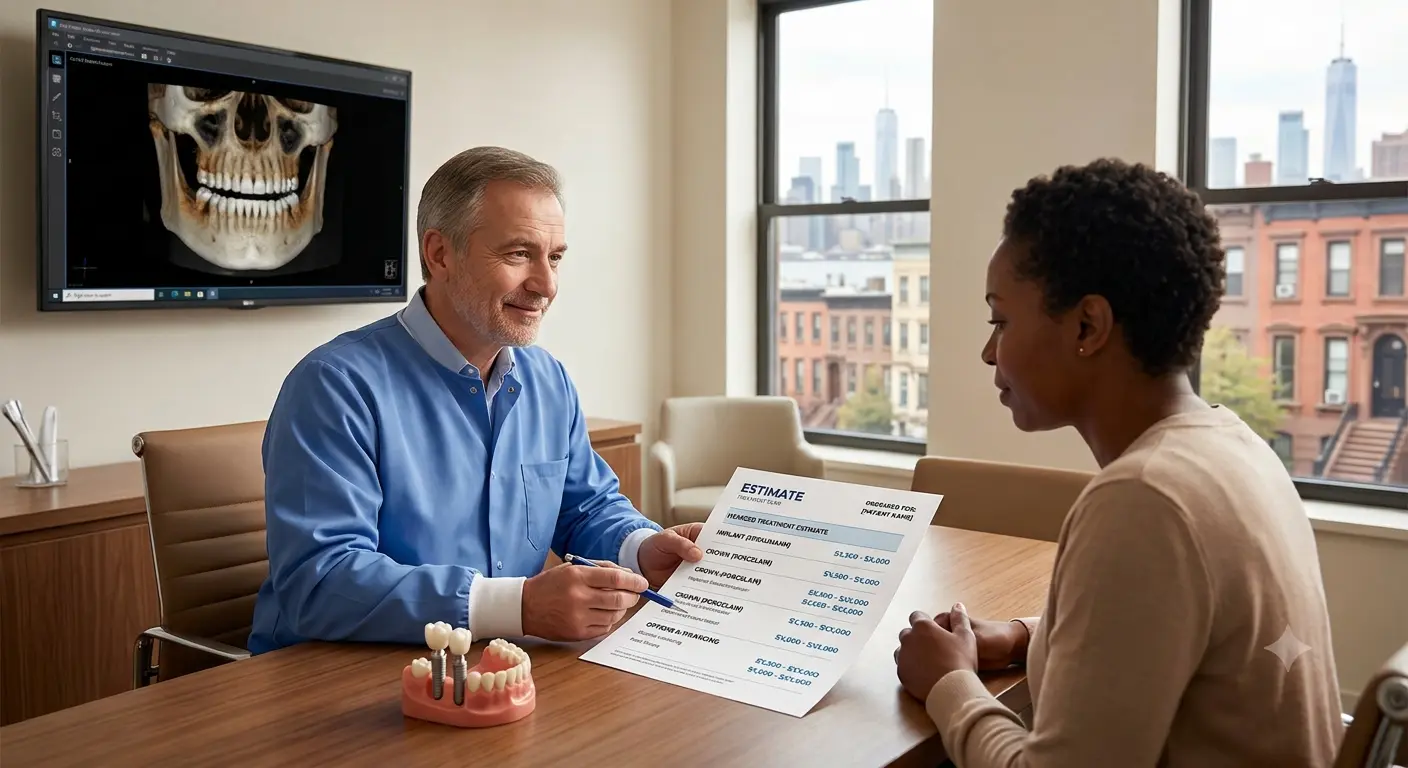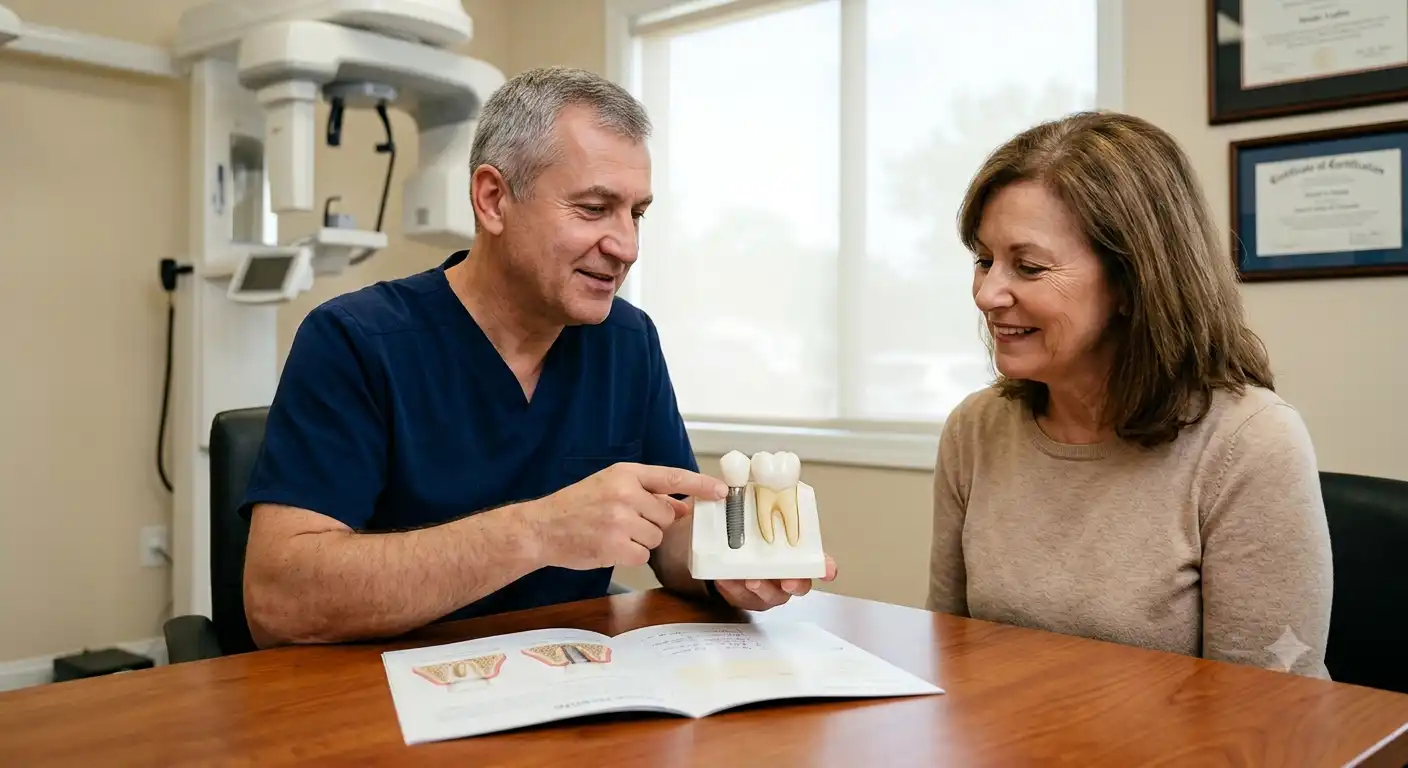


Losing a tooth changes more than your smile. It changes how you eat, how you speak, and — in ways patients often don’t expect — how you carry yourself in everyday life. The two most common tooth replacement options are dental implants and dentures. Both solve the same problem. But they do it in very different ways, with very different consequences over time.
This guide breaks both options down honestly, so you can walk into your consultation already informed.
What Are Dental Implants?
A dental implant is a titanium post surgically placed into the jawbone, where it bonds with the bone through a biological process called osseointegration. Once integrated, a custom crown is attached on top. The result looks, feels, and functions like a natural tooth — because it’s anchored in exactly the same position your natural tooth root used to occupy.
At Bright Smile Dental in Brooklyn, Dr. Vadim offers single-tooth implants, same-day implants, and full-arch All-on-X solutions for patients with more extensive tooth loss. You can see real results from our implant patients in our gallery.
What Are Dentures?
Dentures are removable prosthetics that replace missing teeth. Full dentures replace an entire arch; partials fill gaps where several teeth are missing. They’re held in place by suction, adhesive paste, or clasps on remaining teeth. Importantly, dentures sit on top of the gum tissue — they have no connection to the jawbone underneath. That distinction matters more than most people realize, and we’ll come back to it.
The Case for Dental Implants
- Permanent and stable. Implants are fixed in place. No adhesive, no slipping mid-sentence, no taking them out before bed.
- They protect your jawbone. This is the biological advantage most patients don’t know about. When a tooth root is lost, the jawbone beneath it begins to reabsorb— the body withdraws bone it no longer needs to support. A study published in the International Journal of Oral and Maxillofacial Surgery documented bone volume losses of up to 25% in the jaw within the first year following tooth extraction. Implants are the only replacement option that provides the same mechanical stimulation as a tooth root, and finally halts that process.
- Natural appearance. Each crown is custom-matched in shape and shade to blend with your surrounding teeth.
- Long-term durability. With proper care, the implant post itself can last a lifetime. The crown typically needs replacement after 15–20 years.
- No impact on adjacent teeth. A bridge requires grinding down healthy neighboring teeth as anchors. An implant stands entirely independently.
- Where implants ask more of you: The upfront cost is higher, a surgical procedure is required, and the full process — from placement to final crown — typically spans several months while the implant integrates.
The Case for Dentures
- Lower initial cost. For patients on a tighter budget, dentures are significantly less expensive at the outset.
- No surgery. A good option for patients whose health makes surgery unsuitable.
- Faster. You can have dentures placed much sooner than the implant timeline allows.
- Where dentures fall short: Because they don’t stimulate the jawbone, bone resorption continues. This gradually reshapes the face and changes the fit of the dentures — which is why they typically need relining or replacing every 5–7 years. Many patients also find the stability unreliable, particularly with eating and speaking. Over a 15 to 20-year horizon, the compounding costs of replacements, relines, adhesives, and potential bone loss often surpass the total cost of implants.
Implant-Supported Dentures: A Middle Ground
If full implants feel out of reach but you’re frustrated with the instability of conventional dentures, implant-supported dentures offer a compelling middle option. A small number of strategically placed implants anchor the denture securely, eliminating the slip problem while still protecting the underlying bone. Dr. Vadim offers this as part of the All-on-X full-arch program.
Which Is Right for You?
There’s no universal answer. The right choice depends on your bone density, overall health, the number of missing teeth, and your long-term goals.
What we can say clearly is that implants are the better long-term investment for most patients who qualify clinically. Dentures are a genuine option when surgery isn’t possible or when cost is an immediate barrier — but it’s worth understanding what you’re trading away.
The most important first step is a proper clinical assessment. Bone density, gum health, and your overall medical picture all factor into which path makes the most sense.
Ready to find out which option suits you? Dr. Vadim offers implant consultations at our Brooklyn practice.