
If you’ve started researching full-arch dental implants, you’ve likely come across the terms All-on-4 and All-on-6. Both are permanent, fixed solutions for patients who have lost most or all of their teeth in an arch. Both use implants to support a full set of prosthetic teeth. But they’re not the same procedure, and which one is appropriate for you depends on your specific anatomy, bone condition, and clinical goals.
Here’s what you need to know — in plain language.
What Is All-on-4?
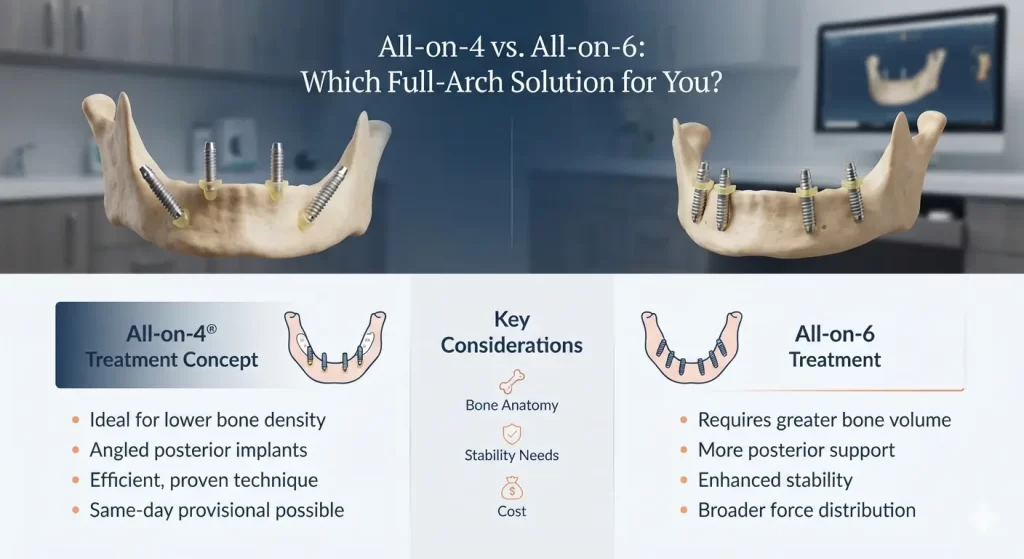
All-on-4 uses four implants per arch to support a full set of teeth. Two implants are placed vertically at the front of the jaw; two are placed at an angle (typically 30–45 degrees) toward the back. The angled placement compensates for the fact that the rear of the jaw often has less bone density, allowing the procedure to work for patients who might not qualify for traditionally placed implants.
The technique was pioneered by Dr. Paulo Maló and has been studied extensively. Clinical research published in the Clinical Oral Implants Research journal has demonstrated cumulative survival rates above 94% at 10 years for All-on-4 restorations.
At Bright Smile Dental, we offer All-on-X full-arch implant treatment with same-day provisional teeth in many cases, so patients leave their appointment with a functional smile on the day of surgery.
What Is All-on-6?
All-on-6 follows the same concept but uses six implants per arch instead of four. The two additional implants are typically placed in the posterior region of the jaw. This distributes chewing forces across a broader base.
The ‘X’ in All-on-X refers to this flexibility: the number of implants is chosen based on your individual anatomy and the clinical judgment of your implant dentist, not a one-size-fits-all protocol.
Key Differences: All-on-4 vs All-on-6
- Bone requirements: All-on-4 is specifically designed to address reduced bone density through angled implant placement. All-on-6 generally requires a greater amount of healthy bone, but when that bone is present, the additional anchoring points can enhance stability.
- Load distribution: More implants spread the bite force across a larger surface area. In patients who put significant stress on their restorations through habits like bruxism (teeth grinding) or in those with particularly dense diets, All-on-6 may offer a more durable foundation.
- Candidacy: A patient with significant bone loss may only be a candidate for All-on-4, either as a standalone solution or as a bridge to All-on-6 following bone grafting. A patient with strong posterior bone density and a preference for maximum stability may be better suited to All-on-6.
- Cost: All-on-6 carries a higher cost due to additional implants, additional surgical time, and more complex prosthodontic work. The difference varies significantly by practice and case complexity.
- Recovery: Both procedures carry similar recovery profiles. Swelling, soreness, and dietary restrictions (soft foods for 4–6 weeks) apply to both.
What About All-on-8?
Some patients with particularly complex bone situations or very large jaw structures are candidates for eight implants per arch. The “All-on-X” umbrella covers all of these configurations — the number is always determined by the clinical picture, not by a default setting.
Who Decides?
Your implant dentist decides, after a proper 3D CBCT scan that images your jawbone structure in detail. No reputable practice should be quoting you All-on-4 vs All-on-6 without that imaging. It’s not a choice between a cheaper and more expensive version of the same thing; it’s a clinical decision based on your bone anatomy.
What patients should be asking isn’t “which one is better” but “which one is right for my jaw.”
What to Expect at Bright Smile Dental
Dr. Vadim performs a full implant assessment before recommending any full-arch treatment. That includes a review of your bone density, gum health, bite, and medical history. If you’re a same-day candidate, we’ll also discuss what that timeline looks like.
You can explore our full-arch implant page here, or browse before-and-after cases from our full mouth reconstruction patients to see what’s possible.
Thinking about All-on-4 or All-on-6? Start with a consultation. We’ll tell you exactly what your jaw supports and what the best path looks like for you.